
As artificial intelligence continues to reshape the gaming industry, developers are increasingly turning to AI-powered tools to enhance their workflows and push creative boundaries. Here’s an in-depth look at four leading AI tools making waves in game development, including their key features, industry applications, strengths, weaknesses, pricing, and future outlook.
1. Unity ML-Agents
Website: Unity ML-Agents
Key Features:
- Open-source toolkit for creating and training intelligent agents
- Seamless integration with the Unity game engine
- Supports a wide range of game genres and AI applications
Application in Game Development:
- Developing smarter, more responsive NPCs
- Creating adaptive difficulty systems
- Automating game testing and balancing
Strengths:
- Free and open-source
- Extensive documentation and community support
- Direct integration with one of the most popular game engines
Weaknesses:
- Steep learning curve for developers new to machine learning
- Requires significant computational resources for training complex models
Pricing: Free
Future Outlook: As machine learning becomes more prevalent in game development, Unity ML-Agents is likely to see continued growth and adoption. Future developments may include more pre-trained models and easier integration with other AI services.
2. NVIDIA GameWorks
Website: NVIDIA GameWorks
Key Features:
- Suite of middleware libraries and tools
- Focuses on real-time graphics and physics simulation
- Includes AI-driven technologies for enhanced visuals and performance
Application in Game Development:
- AI-driven hair and fur simulation
- Intelligent ambient occlusion and global illumination
- Real-time ray tracing optimization
Strengths:
- Cutting-edge graphics technologies
- Strong support for NVIDIA GPUs
- Regular updates with new features
Weaknesses:
- Can be resource-intensive, especially on non-NVIDIA hardware
- Some features may require significant optimization for cross-platform performance
Pricing: Free for developers, but may require licensing for commercial use
Future Outlook: With the increasing focus on photorealistic graphics in games, NVIDIA GameWorks is likely to continue innovating in AI-driven rendering techniques, particularly in real-time ray tracing and advanced physics simulations.
3. Substance Alchemist (now part of Adobe Substance 3D)
Website: Adobe Substance 3D
Key Features:
- AI-powered material creation tool
- Automatically generates PBR materials from images
- Integrates with other Substance tools and major game engines
Application in Game Development:
- Rapid prototyping of game environments
- Consistent material creation across large game worlds
- Time-saving for artists, allowing focus on creative aspects
Strengths:
- Intuitive user interface
- High-quality output with minimal user input
- Part of a larger ecosystem of 3D tools
Weaknesses:
- Subscription-based pricing may be costly for smaller studios
- Learning curve for maximizing AI capabilities
Pricing: Part of Adobe Substance 3D subscription, starting at $19.99/month for individuals
Future Outlook: As part of Adobe’s 3D ecosystem, Substance Alchemist is likely to see continued integration with other Adobe products and further improvements in AI-driven material generation, potentially expanding into procedural 3D model generation.
4. Artomatix ArtEngine (now owned by Unity)
Website: Unity ArtEngine
Key Features:
- AI-powered 3D content creation software
- Automates tedious aspects of 3D asset creation
- Seamlessly removes seams and artifacts in textures
Application in Game Development:
- Rapid generation of diverse textures from limited inputs
- Automatic removal of artifacts in photogrammetry scans
- Creation of tileable textures for expansive game worlds
Strengths:
- Significant time-saving for texture artists
- High-quality output for large-scale environment creation
- Integration with Unity game engine
Weaknesses:
- Relatively high learning curve
- Can be expensive for smaller studios
Pricing: Contact Unity for custom pricing
Future Outlook: Now under Unity’s umbrella, ArtEngine is likely to see tighter integration with the Unity engine and potential expansion into other areas of AI-driven content creation, such as 3D model generation and optimization.
Comparison and Industry Trends
When comparing these tools, we see a trend towards increased automation and AI assistance in traditionally time-consuming tasks. Unity ML-Agents stands out for its focus on gameplay AI, while the others primarily target asset creation and visual fidelity.
In terms of accessibility, Unity ML-Agents and NVIDIA GameWorks offer free entry points, making them attractive for indie developers and students. However, they may require more technical expertise. Substance Alchemist and ArtEngine, while more user-friendly, come with higher price tags that may be better suited for professional studios.
Looking ahead, we can expect these tools to become more integrated, potentially offering end-to-end solutions for game development. The industry is likely to see increased focus on:
- Procedural content generation using AI
- More sophisticated AI-driven character behaviors
- Hyper-realistic graphics powered by machine learning
- AI-assisted game design and balancing
As these tools evolve, game developers will need to stay adaptable, continuously learning to leverage new AI capabilities while maintaining the core creative vision that drives compelling game experiences.
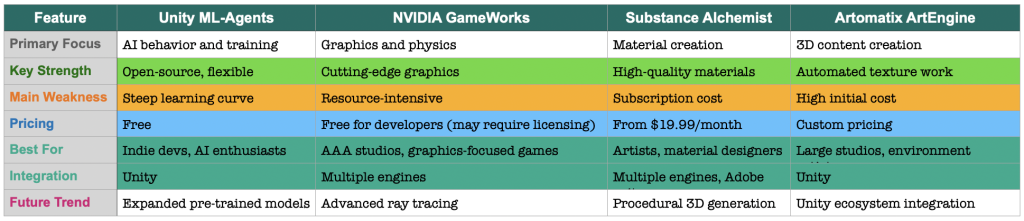
This table provides a quick overview of each tool’s main characteristics, allowing developers to easily compare and identify which tools might best suit their specific needs and projects.
When choosing between these tools, developers should consider:
Their specific project requirements
Budget constraints
Team expertise and learning capacity
Desired level of automation vs. manual control
Integration with existing workflows and engines
Remember that the AI landscape in game development is rapidly evolving. While these tools represent some of the current leaders in the field, new solutions are constantly emerging. Staying informed about the latest developments and being willing to adapt your toolkit will be crucial for success in the AI-driven future of game development.
 using WordPress and
No responses yet